High-Integrity dMRV for Forestry, REDD+, and Terrestrial Carbon
Kumi Analytics delivers scalable, audit-defensible digital MRV for Afforestation, Reforestation, and Revegetation (ARR) projects and jurisdictional REDD+ programs. The same multi-sensor SAR fusion methodology that powers Kumi's industry-leading blue carbon dMRV is applied to terrestrial forests — delivering above-ground biomass estimation, dynamic deforestation baselining, and continuous forest degradation alerts across projects from 1,000 to over one million hectares.
Request Project Assessment
The Challenge of Forest Carbon Projects
Mangroves are the hardest ecosystem on Earth to measure accurately—structurally complex, tidally inundated, and perpetually cloud-covered. Kumi Analytics delivers audit-grade dMRV in those conditions; the same multi-sensor rigor brings unparalleled precision to terrestrial forestry, REDD+, and restoration programs.
Forest carbon projects face intense scrutiny from rating agencies, buyers, and auditors. Inaccurate baselines, over-credited additionality, and undetected degradation can lead to project downgrades, credit reversals, and reputational damage.
Kumi Analytics provides the high-integrity data that forest projects need to succeed. Our multi-sensor approach combines high-resolution optical imagery with SAR to deliver accurate carbon stock estimates, continuous deforestation monitoring, and defensible reporting for audits and rating reviews.
Comprehensive Forest Monitoring
Carbon Stock & Soil Organic Carbon (SOC) Quantification
Kumi Analytics estimates Above-Ground Biomass (AGB) using ecosystem-specific allometric models validated against field inventory data. For complete ecosystem carbon accounting, we also support Soil Organic Carbon (SOC) estimation by integrating satellite-derived canopy density, moisture indices, and vegetation proxies with field calibration data thus ensuring full compliance with IPCC Tier 2 and Tier 3 accounting requirements.
Deforestation Detection
Automated alerts for forest loss events with precise location and area quantification. Near real-time monitoring enables rapid response to illegal logging.
Forest Health Assessment
Multi-spectral indices track canopy health, stress indicators, and degradation. Identify areas requiring intervention before significant carbon loss occurs.
Suitable Area Identification
Identify optimal locations for reforestation and afforestation based on soil type, slope, aspect, and historical land cover.
Canopy Density Mapping
Detailed canopy cover analysis supports additionality claims and tracks restoration progress with temporal comparison.
MRV Reporting
Comprehensive Monitoring, Reporting, and Verification (MRV) reports aligned with VERRA, Gold Standard, and other certification requirements.
Multi-Sensor Technology for Maximum Accuracy
SAR Sensors penetrate for All-Weather Monitoring
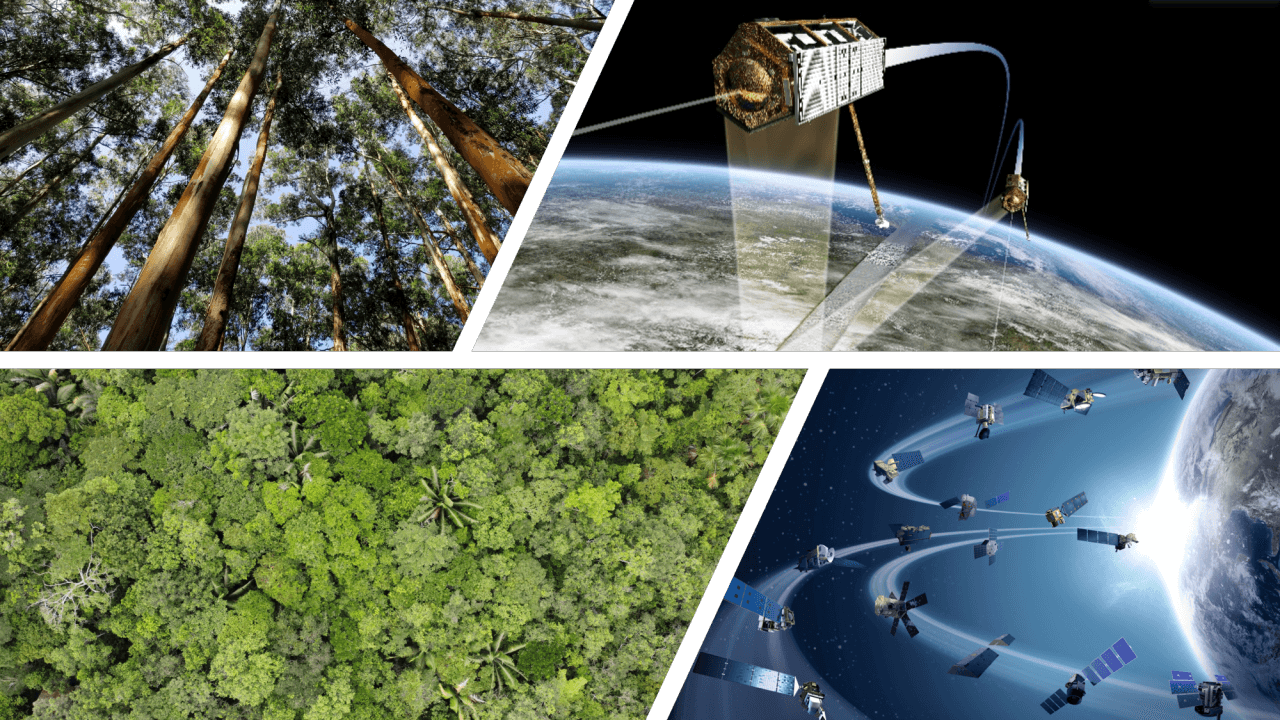
C-Band and L-Band SAR sensors penetrate clouds and operate day or night, ensuring continuous monitoring regardless of weather conditions. SAR data enables:
- Detection of canopy disturbances and clearings
- Biomass estimation through backscatter analysis
- Change detection in tropical regions with persistent cloud cover
Very High-Resolution Optical Imagery
Our 0.5-meter resolution imagery enables individual tree crown delineation and precise forest structure analysis. Eight-band multispectral data provides vegetation health indices (NDVI, EVI, SAVI), species differentiation and biodiversity assessment, and canopy gap detection and forest structure metrics.
AI-Powered Analysis
Our proprietary machine learning algorithms are trained on extensive field data and continuously refined. We provide uncertainty quantification for all estimates and validate results against independent datasets.
How SAR Wavelengths Enable Forest Structure Analysis
Kumi Analytics uses multiple SAR wavelengths to characterize forest structure at different canopy depths:
L-band SAR (ALOS-2/PALSAR, NISAR)
Penetrates dense tropical forest canopies to measure woody biomass in the trunk and large branches. Most effective for high-biomass forests (>200 Mg/ha). Essential for REDD+ projects in tropical regions.
C-band SAR (Sentinel-1)
Sensitive to surface canopy and smaller branches. Used for deforestation detection, forest/non-forest mapping, and monitoring early-stage regrowth.
X-band SAR
High-resolution surface returns for canopy height estimation and forest structure characterization.
Together, multi-wavelength SAR fusion provides a complete vertical profile of forest biomass — from the canopy surface to the trunk — that no single sensor can achieve alone.
Scalable from 1,000 to 1M+ Hectares
Our cloud-based platform enables cost-effective analysis of projects of any size. Whether you're monitoring a small restoration site or a landscape-scale conservation program, we deliver consistent accuracy and rapid turnaround.
1 week
Feasibility analysis ready
3 months
Complete baseline analysis
Continuous
Ongoing monitoring and alerts
Benefits for Your Forest Carbon Project
Higher Credit Ratings
Accurate, defensible data supports higher ratings from carbon rating agencies.
Reduced Risk
Continuous monitoring and early detection minimize risk of project downgrades, credit reversals, or reputational damage.
Premium Pricing
High-integrity projects command premium pricing and attract quality buyers in voluntary carbon markets.
Elevate Your Forest Carbon Project
Contact us to discuss how we can support your forest conservation, reforestation, or REDD+ project.
Request Project Assessment